
Why Are There Different Bible Versions?
The Bible was originally written in:
- Hebrew (most of the Old Testament)
- Aramaic (small portions of the Old Testament)
- Greek (the New Testament)
Because languages change over time, scholars have produced different English translations. These translations generally follow one of two approaches:
- Word-for-word (formal equivalence): Tries to stay as close as possible to the original wording.
- Thought-for-thought (dynamic equivalence): Focuses on communicating the original meaning in natural, modern English.
Both approaches can be faithful to Scripture, but they differ in style and readability.
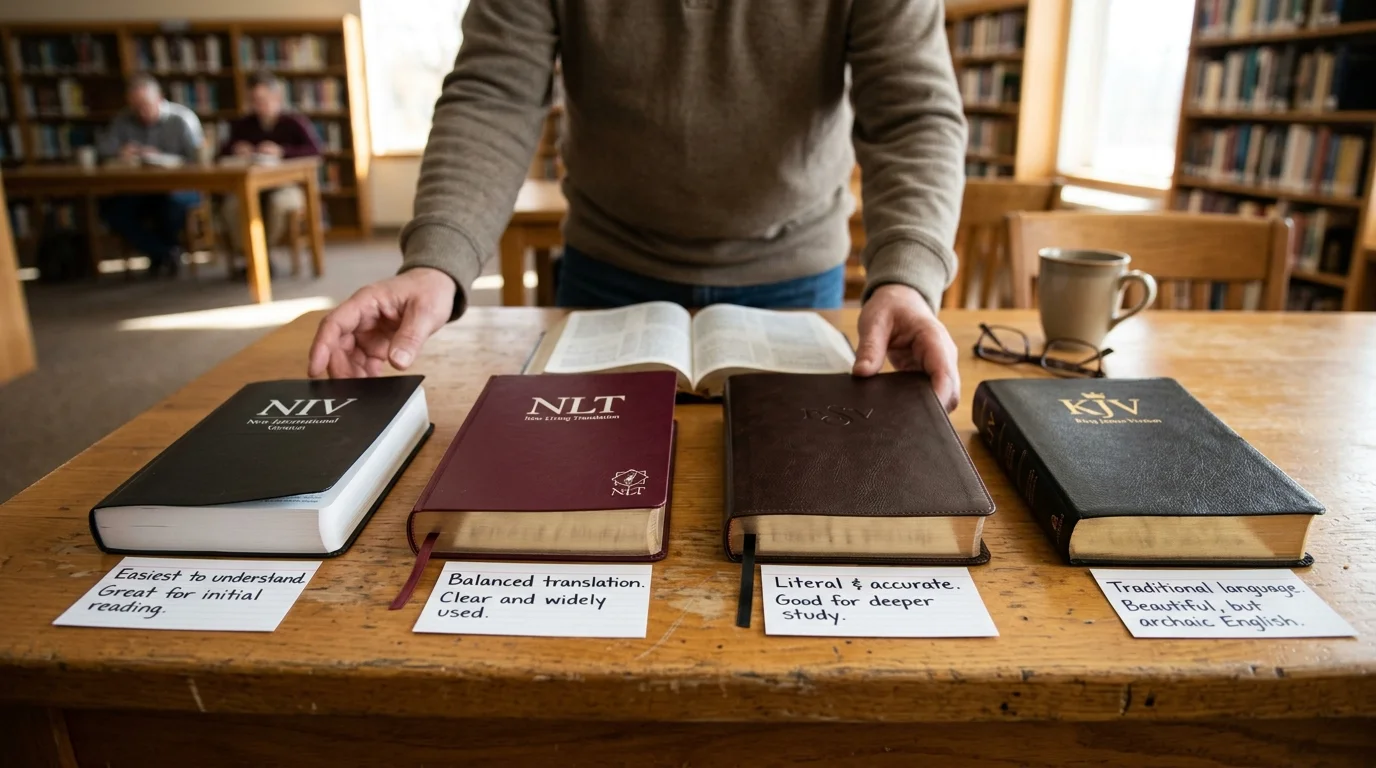
Best Bible Versions for Beginners
1. New International Version (NIV)
Best For
- First-time Bible readers
- Daily devotions
- Personal Bible study
- Church use
Strengths
- Clear and modern English.
- Balanced accuracy and readability.
- Widely used by churches, study groups, and Bible teachers.
- Easy to understand without oversimplifying the text.
Considerations
Because it balances readability with faithfulness to the original languages, many people consider the NIV one of the best all-around choices for beginners.
2. New Living Translation (NLT)
Best For
- New believers
- Younger readers
- Daily reading
- Easy comprehension
Strengths
- Very conversational and easy to read.
- Explains ideas in natural English.
- Excellent for people who are reading the Bible for the first time.
Considerations
The NLT prioritizes clarity, so it sometimes expresses ideas more freely than more literal translations while aiming to preserve the original meaning.
3. Christian Standard Bible (CSB)
Best For
- Beginners who want both readability and close attention to the original text.
- Personal study.
- Small group discussions.
Strengths
- Smooth, modern English.
- Good balance between literal accuracy and readability.
- Increasingly popular among churches and pastors.
Considerations
The CSB is an excellent choice if you want a translation that is easy to read while remaining relatively close to the original wording.
4. English Standard Version (ESV)
Best For
- Readers who enjoy a more literal translation.
- In-depth Bible study.
- Memorizing Scripture.
Strengths
- Highly respected for its word-for-word approach.
- Often used in Bible study and teaching.
- Preserves much of the structure of the original languages.
Considerations
The ESV can be slightly more challenging for beginners because of its more formal language, but many readers appreciate its precision.
5. New King James Version (NKJV)
Best For
- Readers who appreciate traditional biblical language with updated wording.
- Church reading.
- Long-term Bible study.
Strengths
- Retains much of the literary beauty of the King James tradition.
- Modernizes many outdated words while preserving a formal style.
Considerations
Some expressions may still feel more formal than those found in newer translations.
Quick Comparison
| Bible Version | Reading Level | Translation Style | Best For |
|---|---|---|---|
| NIV | Easy | Balance of word-for-word and thought-for-thought | Most beginners |
| NLT | Very Easy | Thought-for-thought | First-time readers |
| CSB | Easy | Balanced | Beginners and study |
| ESV | Moderate | Word-for-word | Deeper study |
| NKJV | Moderate | Formal | Traditional readers |
Which Bible Version Should You Choose?
Choose the NIV if…
You want the best overall balance of readability and accuracy.
Choose the NLT if…
You want the easiest English to understand.
Choose the CSB if…
You want a modern translation that combines clarity with close attention to the original text.
Choose the ESV if…
You plan to spend significant time studying Scripture in depth.
Choose the NKJV if…
You enjoy traditional wording but prefer updated English over the original King James Version.

Tips for New Bible Readers
Start With the Gospel of John
John introduces the life, teachings, and purpose of Jesus Christ in a clear and accessible way.
Read a Little Every Day
Consistency is more important than reading large portions at once. Even one chapter a day can build a lasting habit.
Pray Before Reading
Ask God for wisdom, understanding, and a heart that is open to His Word.
Read in Context
Instead of focusing only on individual verses, read complete chapters and sections to understand the author’s message.
Consider a Study Bible
A beginner-friendly study Bible includes introductions, maps, notes, and explanations that can help you better understand Scripture.
A Prayer Before Reading the Bible
Heavenly Father,
Thank You for giving us Your Word. As I begin reading the Bible, help me understand Your truth and grow closer to You. Give me wisdom to learn from Scripture, faith to trust Your promises, and courage to live according to Your will. Guide me through Your Holy Spirit and help Your Word shape my heart each day.
In Jesus’ name, Amen.