
Biblical Background: Why Are There Different Bible Versions?
The books of the Bible were originally written in Hebrew, Aramaic, and Greek. Because most readers today do not speak these ancient languages, scholars have carefully translated the Scriptures into modern languages while seeking to preserve their original meaning.
2 Timothy 3:16–17 says,
“All Scripture is God-breathed and is useful for teaching, rebuking, correcting and training in righteousness, so that the servant of God may be thoroughly equipped for every good work.” (NIV)
This passage emphasizes that Scripture is inspired by God.
Bible translators generally follow one of three approaches:
- Formal equivalence (word-for-word): Attempts to stay as close as possible to the original wording. Examples include the ESV and NASB.
- Dynamic equivalence (thought-for-thought): Focuses on communicating the original meaning in natural, modern language. The NIV and NLT often use this approach.
- Balanced approach: Seeks a middle ground between accuracy and readability. The CSB is a well-known example.
Although wording may vary, trusted translations preserve the central teachings of the Christian faith.
Key References From Core Bible Books
Several books of the Bible emphasize the importance of God’s Word itself rather than the language into which it is translated.
The book of Psalms celebrates Scripture as God’s guidance. Psalm 119:105 says,
“Your word is a lamp for my feet, a light on my path.” (NIV)
This verse reminds believers that God’s Word directs their lives.
The book of Proverbs highlights the perfection of God’s truth. Proverbs 30:5 declares,
“Every word of God is flawless; he is a shield to those who take refuge in him.” (NIV)
The book of James encourages believers to obey Scripture. James 1:22 says,
“Do not merely listen to the word, and so deceive yourselves. Do what it says.” (NIV)
The Gospel of John reveals Jesus as the eternal Word. John 1:1 states,
“In the beginning was the Word, and the Word was with God, and the Word was God.” (NIV)
Together, these passages remind us that the power of Scripture lies in its divine message, faithfully communicated through trustworthy translations.
Spiritual Interpretations
1. God’s Word Is Trustworthy
“Every word of God is flawless.” — Proverbs 30:5 (NIV)
The Bible’s authority comes from God, not from a particular English translation.
Faithful translations seek to preserve the truth of the original Scriptures.
Believers can read with confidence, knowing God’s message endures.
2. Scripture Is Meant to Be Understood
“The unfolding of your words gives light.” — Psalm 119:130 (NIV)
God desires His people to understand His Word.
Choosing a translation that matches your reading level can make regular Bible study more meaningful.
Understanding leads to spiritual growth and faithful living.
3. God’s Word Calls for Obedience
“Do not merely listen to the word… Do what it says.” — James 1:22 (NIV)
The purpose of Bible reading is transformation.
No matter which faithful translation you choose, God’s Word invites you to trust Him and obey His commands.
A Bible that is consistently read will have a greater impact than one left unopened.
4. Jesus Is the Center of Scripture
“The Word became flesh and made his dwelling among us.” — John 1:14 (NIV)
Every faithful Bible translation points readers to Jesus Christ.
The goal of reading Scripture is not merely gaining knowledge but growing in a relationship with Him.
Christ is the heart of the Bible’s message.
Variations & Related Themes
Each Bible translation serves different readers and study purposes.
| Bible Version | Translation Style | Best For |
|---|---|---|
| NIV (New International Version) | Balanced thought-for-thought | Daily reading, church, personal devotion |
| ESV (English Standard Version) | Word-for-word | In-depth Bible study, preaching, memorization |
| NKJV (New King James Version) | Formal equivalence | Readers who appreciate traditional language with updated vocabulary |
| NLT (New Living Translation) | Thought-for-thought | New believers, devotional reading, children, and families |
| CSB (Christian Standard Bible) | Balanced | Personal study and readability |
| NASB (New American Standard Bible) | Very literal | Detailed word studies and academic study |
| KJV (King James Version) | Formal equivalence (1611 tradition) | Traditional reading, literary beauty, memorization |
Many Christians find it helpful to read more than one translation. For example, they may use the ESV for study and the NIV or NLT for devotional reading.
Faith-Based Action Steps
1. Pray Before Reading the Bible
Sample Prayer:
“Heavenly Father, thank You for preserving Your Word through the generations. As I read the Bible, give me wisdom and understanding through Your Holy Spirit. Help me choose a faithful translation that allows me to know You more deeply and live according to Your truth. In Jesus’ name, Amen.”
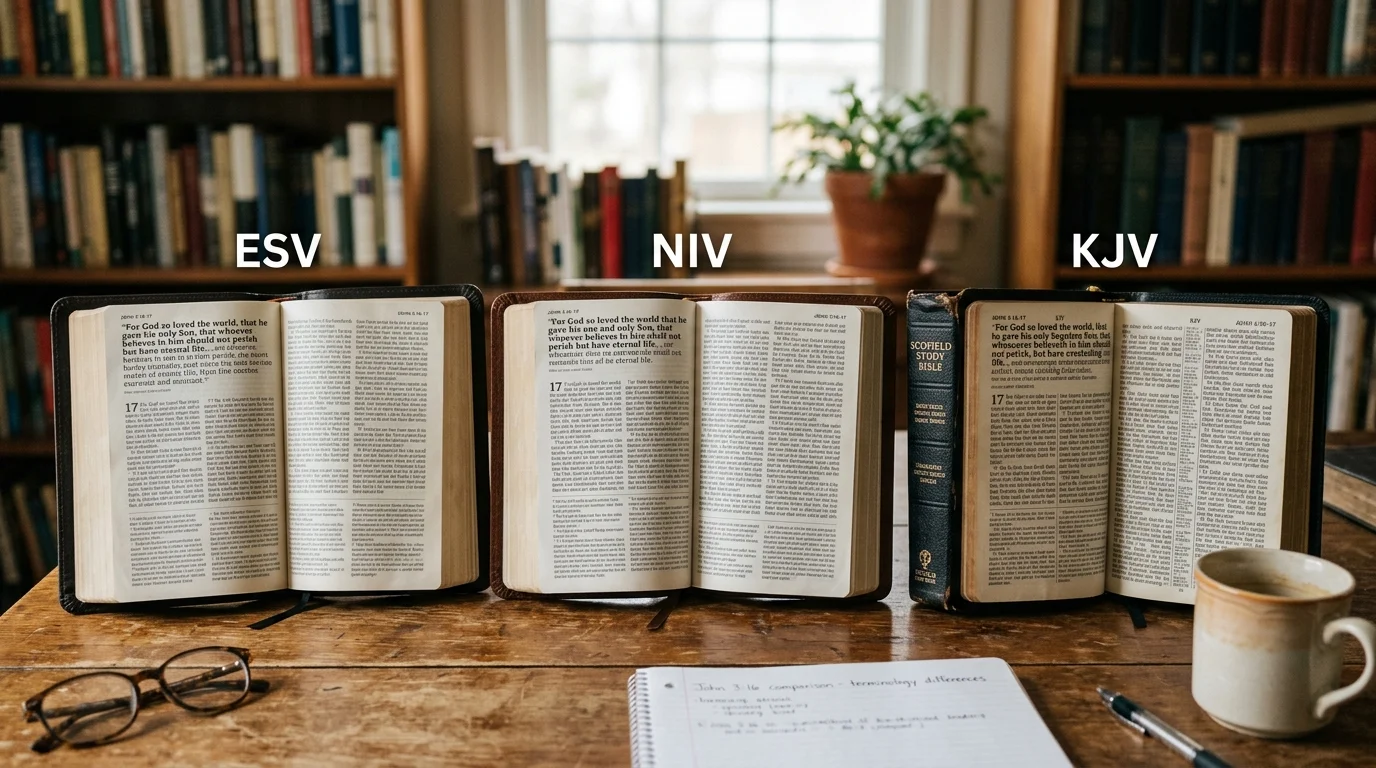
2. Compare Translations Thoughtfully
Read the same passage in two trusted translations.
Ask yourself:
- What truths remain the same?
- What wording helps me understand the passage more clearly?
- How can I apply this Scripture today?
Comparing translations often deepens understanding without changing the Bible’s message.
3. Study With Christian Community
Join a Bible study group or speak with your pastor if you have questions about translations.
Learning alongside other believers helps you grow in wisdom and confidence as you study God’s Word.